What Banff is like on the ground
Banff is a small mountain town inside Canada's first national park, and travelers agree it earns its fame. Writers describe turquoise lakes, a gondola above town, hot springs and a main street of shops and restaurants under peaks that fill every view. The famous sights are spread out, though. Lake Louise is roughly 40 minutes from town by road and Moraine Lake sits beyond it, so a day out means a drive, a bus or a shuttle, not a stroll.
Crowds are the other fact of life. The town counted 1.8 million vehicles entering in July and August 2026, and its free train station lot filled by 11 a.m., about 45 minutes earlier than the year before. A mid September forum poster was surprised by tour groups, and a family at Peyto Lake did not mind the waiting but did notice the throngs. Early June travelers say the opposite: everything had just opened for the season and they never felt rushed.
Banff is not cheap. Park entry is CAD 12.25 per adult per day (about EUR 7.79 at the ECB rate of 2026-11-20), with youth 17 and under free, or CAD 83.50 for an annual Discovery Pass (about EUR 53.11). The Banff Upper Hot Springs charge CAD 19.75 for an adult (about EUR 12.56). Gondola prices change by date and time, so check them at booking. Hotels are the biggest cost, which is why many families look at Canmore.
Lake Louise and Moraine Lake without a private car
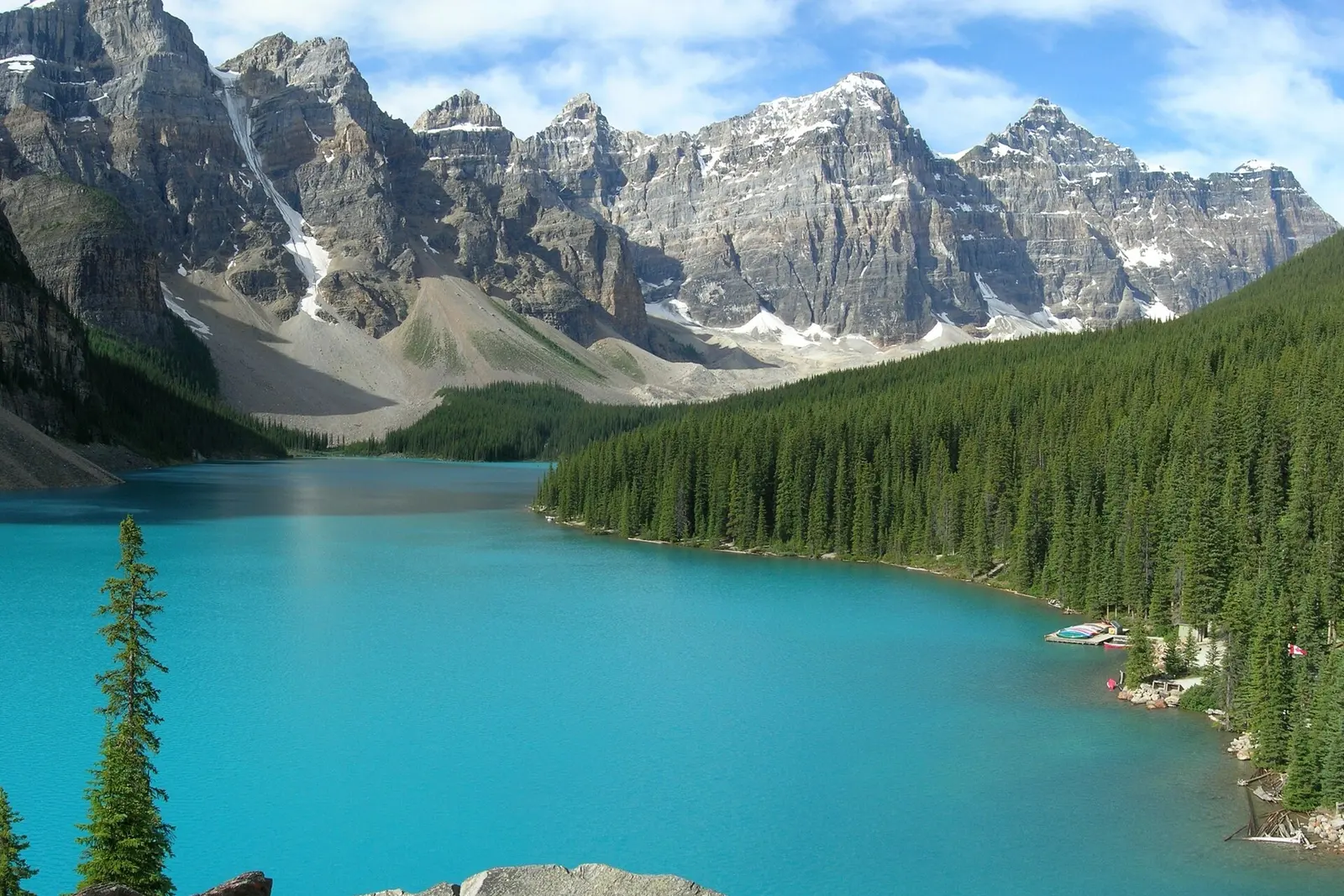
Moraine Lake Road is closed to personal vehicles year-round. You reach the lake by the Parks Canada shuttle, a licensed commercial operator, or Roam's reservable pass with the Lake Connector. In 2026 the Parks Canada shuttle ran to Lake Louise from May 15 and to Moraine Lake from June 1, both until October 12. Reservations opened on April 15 at 8 a.m. Mountain time, with 40 percent of seats released at launch and more at 8 a.m. two days before each departure.
An adult seat costs CAD 12.75 (about EUR 8.11), a senior seat CAD 6.00 (about EUR 3.82) and a youth seat CAD 4.00 (about EUR 2.54), plus a non-refundable online reservation fee of CAD 3.50 per booking (about EUR 2.23). Park entry is separate. One ticket covers both lakes through the Lake Connector, and you check in at the Lake Louise Park and Ride, where parking is free for reservation holders. The Alpine Start departures at 4 and 5 a.m. leave from the lakeshore lot instead, where parking is paid.
Travelers report that planning pays off. A forum poster who booked late found shuttle seats on only one of four days, and a family says the Consolation Lakes trail was quiet because most people stop at the Rockpile viewpoint. Moraine Lake has no cell service, Wi-Fi or running water, so download maps and bring water. If you drive to Lake Louise instead, lakeshore parking is CAD 42.00 per vehicle from May 15 to October 12 (about EUR 26.71).
The 2026 shuttle season ended on October 12, and the Parks Canada page still lists 2026 dates, so check it again before planning a 2027 trip. In the colder months Roam sells a reservable day pass that includes a round trip on Route 8X to Lake Louise, but there is no Moraine Lake shuttle.
Where to base yourself: Banff, Canmore or Lake Louise
Banff town suits most first trips and anyone without a car. It has the restaurants, the shops, the Roam hub and the quickest buses to the gondola and Lake Louise. The catch is price: hotels are the biggest trip cost, and writers suggest arriving midweek and looking at neighboring towns to save money.
Canmore is the value choice. A couple who based there drove to nearly every activity, so a car was a must for them, and another visitor suggests Canmore for cheaper rooms. It is about 20 to 25 minutes from Banff by road, and Lake Louise is roughly an hour away, compared with about 40 minutes from Banff. Roam's Route 3 links Canmore and Banff, but you need to time it against your lake reservations.
Lake Louise village is the choice for early lake mornings and ski days. A ski forum poster describes the resort as a drive-and-park area about five minutes from the hotels. It has a few lodges and the two grand hotels, but little else, so dinner options are thin. Most visitors split the stay: a night or two at Lake Louise for sunrise, the rest in Banff or Canmore. One couple loved the lakeside hotel but would not repeat the Banff Springs stay, so match the property to the plan.
Car or no car
A car-free trip works if you stay in Banff. One forum poster used a car on only one day of a four-day September trip and called Roam excellent, with generous senior discounts, and a solo October visitor took a Roam bus to the gondola from a stop a block from the hotel. Calgary airport coaches run year-round, Roam covers the gondola, Lake Minnewanka and Lake Louise, and the Parks Canada shuttle or a licensed operator handles Moraine Lake.
A car pays off at the edges: an early start at Johnston Canyon, the Bow Valley Parkway, and the Icefields Parkway. A family that reached the canyon before 8 a.m. avoided both parking trouble and crowds, and one couple said the lack of ride-hailing made a rental car welcome. A forum poster who stopped at Peyto Lake for an hour came back to a line of more than 50 cars waiting for parking. Sulphur Mountain parking is CAD 17.50 (about EUR 11.13), and Roam Route 1 to the gondola costs CAD 2 one way (about EUR 1.27).
From Calgary airport, the Banff Airporter adult one-way fare is CAD 88.90 (about EUR 56.54) and the trip takes about two hours. Brewster Express coaches leave the airport every 90 minutes from 9:30 a.m. to 8 p.m. A rental car costs more once you add park entry, parking and fuel, so count the total before deciding.
Winter: skiing, cold and Christmas
Banff has three ski areas within about 40 minutes: Lake Louise, Sunshine Village and Mount Norquay. A March 2026 forum thread describes Norquay as fun and close to town, but says Sunshine and Lake Louise suit anyone who wants to maximize skiing. The same poster found deep snow in the Lake Louise backside chutes, about 6 inches of fresh powder one morning and a 10 F start, and poor visibility at Sunshine on one day.
A February 2025 ski forum poster found better snow at Sunshine than at Lake Louise, apart from wind high on the mountain, and cloud blocked the views the whole trip. A September 2025 thread adds that Norquay is firmer with less snow than either big resort but worth a day for balance, and that Banff's ambience beats Whistler's for some skiers. The forum consensus is that Lake Louise has the longer runs, Sunshine the better snow, and Banff the nightlife.
Off the slopes, the gondola runs daily from 10 a.m. to 10 p.m. from November 20 to December 31, 2026, and closes from January 4 to 15, 2027 for maintenance. The Banff Upper Hot Springs are open for a post-ski soak. Dress for very cold mornings, and carry snow tires or chains on the Icefields Parkway, where Parks Canada says they are required by law from November 1 to March 31.
Icefields Parkway: day trip or overnight in Jasper
The Icefields Parkway runs 232 km between Lake Louise and Jasper, and the full Banff to Jasper drive is about 287 km, roughly three and a half hours without stops. A day trip from Banff to Peyto Lake, Bow Lake and the Columbia Icefield and back is realistic, but it fills a whole day. One traveler stopped at Peyto and turned back, which is a sensible half-day compromise.
If you continue to Jasper, guides suggest at least two nights there. Fuel is scarce on the parkway, with Saskatchewan River Crossing the only stop between Lake Louise and Jasper, so fill up in Banff or Lake Louise. You need a national park pass even if you never leave the car. Wildfire damage from 2024 is still visible near the Jasper end, and one diarist found Maligne Canyon closed for fire damage, so check conditions before building a plan around it.
Without a car, the parkway is the one place where a guided day tour beats public transport. Winter driving needs snow tires or chains, which Parks Canada requires by law on the Icefields Parkway from November 1 to March 31 or whenever the road is covered with snow or ice, and a check of 511 Alberta.
Wildlife and trail rules
Wildlife is part of the draw, and it is also a safety issue. Two grizzly bears visited a campground near Johnston Canyon while a family stayed there, elk wander through the townsite, and a couple who carried bear spray on a snowy October trail saw no large animals at all. Parks Canada asks visitors to keep at least 100 metres from bears, wolves, cougars and coyotes and 30 metres from deer, elk, sheep and moose. It is illegal to feed, entice or disturb wildlife, with fines up to CAD 25,000 (about EUR 15,900).
Keep dogs on leash, store food securely and drive slowly. Parks Canada also asks hikers to travel in groups, make noise on trails and skip the headphones. Carry bear spray on trails, and read the trail report before you go, since closures and group-access rules change through the summer.